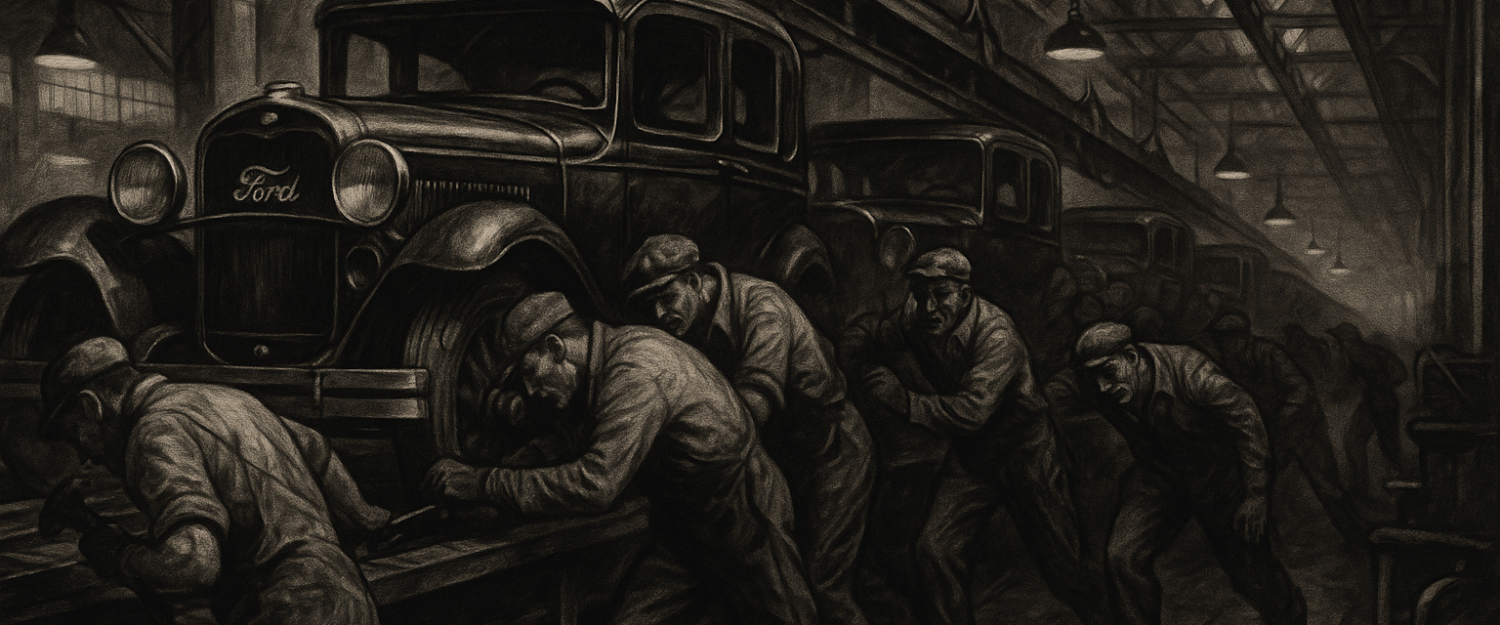

It was 1:00 A.M. and dark when workers wearing white armbands began arriving at the General Motors Chevrolet-Fisher plant in the Leeds District of Kansas City to set up their picket lines. It was a warm night. The men lingered in loose knots, boots scuffing the gravel as they waited. New arrivals were waved into the groups with shouts of recognition. The headlights of incoming cars delivering additional pickets silhouetted the men as they waited for the morning light and the confrontations to come. Most gathered at the Fisher Body entrance to the plant along Highway 40, Missouri’s main east-west highway. Leaders of the strike committee moved back and forth between the strike headquarters nearby and the groups of waiting men to hand out assignments. The day shift was not scheduled to arrive for six more hours.
When the sun came up, 250 men formed a line and began to march up and down in front of the plant entrance. Facing them was a squad of 20 policemen led by Captain Thomas Sullivan of the Flora Avenue Station. Behind them, plant guards patrolled inside the gates.
As the day wore on, reporters raced between the offices of Charles Metcalf, the manager of the Fisher Body side of the plant, E. C. Shaw, the manager of the Chevrolet assembly plant, and W.S. Patterson, the president of Kansas City Local No. 2 of the Federated Automobile Workers of America, at strike headquarters to hear competing claims about whether the strike was already breaking—or just beginning.
Metcalf was cagey about the number of workers who reported for work on the Fisher Body side of the plant, but admitted it was below normal. Shaw told reporters that, “90 per cent of the employees at the assembly plant had reported for work Monday morning.”
Patterson, on the other hand, told reporters that no “more than seventy-five persons had gone into the Fisher plant Monday to work, and declared it would be impossible to operate the plant without a full quota of workers.” Those entering the plant were office employees, foremen, and stockmen.
Patterson pointed out that “the ‘key’ men in both plants had joined the strikers. Of the thirty-one men employed by the Fisher company as sprayers,” he said, “twenty-nine were on strike.” With trainmen refusing to move parts into the plant or take finished vehicles away, the company’s claim that production was proceeding normally had to be taken with a grain of salt.
A Gut Punch
As the sun climbed higher in the sky, strike captains passed the word on the picket line that, while they were voting to strike at the Atheneum the previous night, the Cleveland Fisher Body workers had met at the Labor Temple there and voted conditionally to end their week-old strike and return to work. Soon, everyone was talking about it as they marched up and down the highway in front of the plant. It was a gut punch to men who were risking their jobs and paychecks for the strike. Having one leg cut out from under them on the first day of the strike was not the kind of news anybody wanted to hear, but shoulders squared, heads held high, the determined scuffling of boots on the pavement out front of the plant went on.
At the end of the day, workers, their wives, and children again packed the Atheneum. The mood was tense. Although they shut down production, watching several hundred of their fellow workers, mostly Chevrolet workers who weren’t affected by the layoffs, cross the picket line was dispiriting. Arms folded, jaws clenched, men gathered in tight circles around the meeting hall, muttering that if only everyone at the plant would join the strike, it would soon be over. Shouts echoed off the walls, demonstrating that union recognition, seen as the key to winning their other demands, was at the top of most people’s agendas.
Find Us On Facebook
By 7:00 a.m. Tuesday, May 1, the mood outside the plant shifted. An estimated 1,500 strikers and sympathizers wearing pink armbands were at the factory gates. More policemen were on hand than the previous day. Even so, fistfights erupted immediately. Police sirens blared as strikers tried to stop people from crossing the picket line. Police squads rushed in again and again to push the strikers back from the gates and break up fights. Some of the men who crossed the picket line parked their cars inside the plant gates to keep them safe, but as the morning went on and tensions rose, a group of strikers took up a position on the Kansas City Southern railroad bridge and heaved stones down onto the cars of the men who crossed their line.
At shift change that afternoon, Shaw and Metcalf increased tensions by marching everyone who crossed the picket line out as a group through one of the gates to demonstrate how many men were still at work. Immediately, strikers surged through the streets outside the plant. The shouts of the strikers and the wail of police sirens rose above the crowd. The tactic failed. Instead of thinning the line, it hardened it. The strikers were more determined than ever. As action at the plant ended, the Leeds strikers, their wives and children again filled the Atheneum assembly hall for another mass meeting.
Hold Your Lines
Roosevelt’s National Recovery Act gave workers the right to organize and bargain collectively, Patterson and other strike leaders told the crowd from the platform at the front of the hall. Hold your lines, they pleaded. That’s the only way we can secure the rights guaranteed to us by the government. H. C. Neuman, vice president of the UAW-AFL, based in St. Louis, was on the platform to urge union members and sympathizers to attend a meeting scheduled for the following night. He told everyone he expected to have important news to report.
Patterson, Swift, and other strike leaders closed the meeting by warning workers about carrying weapons. They urged them not to throw rocks. They were backed up by a striker with a bandaged arm who had been stabbed by a worker crossing the picket line. “It’s better to be injured,” he said, “than cause injuries with weapons.”
Hecklers
By early Wednesday morning, women lined the sidewalk in front of a row of stores near the plant. They weren’t there to shop. Instead, they cheered the pickets as the morning shift approached. As workers’ cars backed up along the highway, they heckled the men inside, their voices carrying above the engines and sirens. The men sat stone-faced in their vehicles, waiting for the traffic to clear so they could pull forward and out of earshot of the women’s taunts. Capt. Sullivan increased the police presence outside the plant again, to 18 motorcycle patrolmen and 30 uniformed officers.
Still, the situation escalated. When strikers rushed to block people from crossing their line, sirens wailed. Fists flew, Blackjacks swung. But the line held.
A Kansas City bus ferrying strikebreakers from the streetcar line to the plant was forced to the curb by two cars at 27th and Van Brunt, the hood raised, and the ignition wires jerked out by men police identified as strikers. A number of workers, strikers, and police officers were injured during the day, with at least two requiring hospitalization. Police arrested several men—both workers and strikers—after weapons were discovered, though all were released.
SOURCES
- Contemporary Kansas City newspapers consistently identified striking workers at the Chevrolet–Fisher Body plants in the Leeds district by the white bands worn on their left arms, used both to mark strikers and to distinguish them from non-striking employees as workers arrived and departed the plant. See Kansas City Times, “Union Rein on Strikers,” May 1, 1934, p. 1; Kansas City Journal, “Union Rein on Strikers,” May 4, 1934, p. 2; and Kansas City Journal-Post, “Strikers Picket Leeds Motor Car Plants,” April 30, 1934, p. 1.
- Reports describe pickets assembling before dawn, with lines forming hours before the scheduled arrival of the day shift. The Kansas City Journal-Post noted picketing beginning early on April 30, 1934, while subsequent accounts confirm continuous picket duty through the night and early morning hours as the strike progressed. See Kansas City Journal-Post, April 30, 1934, p. 1; Kansas City Star, “Calm in the Car Strike,” May 2, 1934, p. 3.
- Initial picketing concentrated at the Fisher Body entrance along U.S. Highway 40, Missouri’s principal east-west route, before expanding to additional gates and, later, to the company offices. Police records and press coverage confirm that picket lines were adjusted in consultation with police officials during the first days of the strike. See Kansas City Journal-Post, April 30, 1934, p. 1; Kansas City Journal, May 2, 1934, p. 1.
- Estimates of the number of strikers and pickets varied widely depending on the source. Union officials claimed that as many as 1,500 workers refused to enter the plants, while company managers asserted that most employees remained at work. Police deployments—ranging from twenty to more than forty officers—suggest authorities anticipated large crowds and possible confrontations. See Kansas City Star, “Car Strike Still Urged,” April 29, 1934, p. 1; Kansas City Journal, “Police Guard at Leeds Is Increased,” May 1, 1934, p. 1.
- Press accounts repeatedly emphasize that union leaders urged restraint, warning strikers against carrying weapons or engaging in violence, even as clashes occurred between pickets, non-striking workers, and police. These admonitions were delivered at mass meetings at the Athenaeum on Linwood Boulevard and reiterated on the picket lines. See Kansas City Times, May 1, 1934, p. 1; Kansas City Journal, May 3, 1934, p. 1.
- Despite official appeals for calm, newspapers documented fistfights, heckling, and stone-throwing, particularly as workers attempted to enter or leave the plants. Coverage also records police intervention, injuries to both strikers and workers, and arrests for disorderly conduct and weapons possession. See Kansas City Journal, “Fist Fights and Heckling Mark Strike at Leeds,” May 2, 1934, p. 1; Kansas City Star, May 3–4, 1934, pp. 2–3.
- Company and union statements regarding production levels during the strike were sharply contested. Management claimed operations continued “as usual,” while strike leaders pointed to the participation of key skilled workers, refusal of railroad trainmen to move parts or finished vehicles, and visible reductions in output as evidence that the walkout was effective. See Kansas City Journal-Post, April 30, 1934, p. 1; Kansas City Times, April 30, 1934.