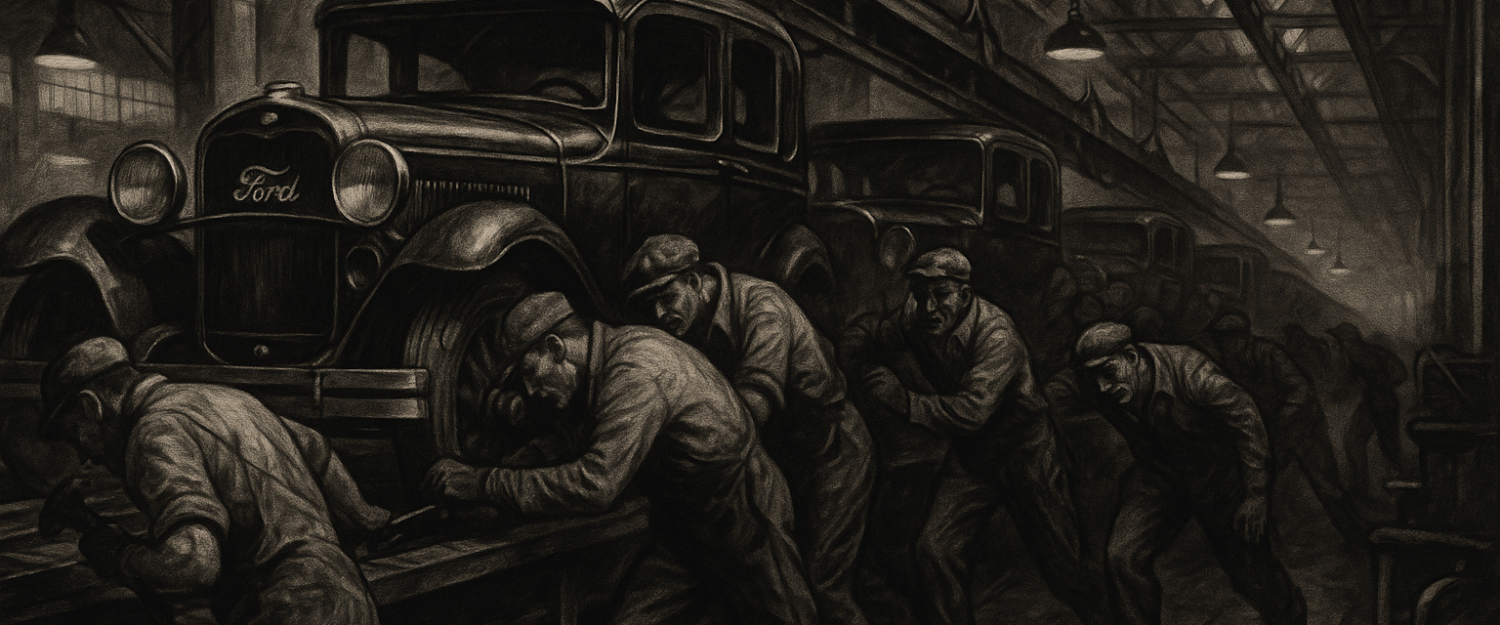

In February 1937, Walter Williams, a leader of the UAW organizing drive at the Ford Kansas City Assembly Plant, was pulled from his job on the No. 1 metal line and escorted to the office of plant superintendent Joseph Bush. Waiting for him were several supervisors, their presence a clear warning.
“Keep your damn mouth shut about the union,” Bush snapped. “There are plenty of tough boys here who will crack your skull for you.”
Williams knew the threat was real. Henry Ford was a fierce opponent of unions. He hired Harry Bennett, an ex-Navy boxer, to run the Ford Service Department—Ford’s private security force—staffed with 3,000 armed men, many of them street thugs and ex-convicts.
Through Bennett, Ford ruled the Rouge Plant like an iron-fisted dictator. Company-backed vigilantes thrived, workers were pushed to spy on one another, and a single word about unions could cost them their jobs. Williams understood all too well that Bennett’s goon squad cast its shadow all the way from Dearborn to Kansas City.
But Williams didn’t back down. He and a small group of UAW organizers believed the time had come to force change at Ford.
The Great Depression, the New Deal, and Workers’ Rights
As Williams returned to the metal line, the country was in the eighth year of the Great Depression. Although unemployment was still high, it had improved from 1933, when one in four Americans was jobless. By early 1937, production, profits, and wages had briefly returned to 1929 levels, sparking hope.
President Franklin D. Roosevelt’s New Deal programs—relief for the unemployed, banking reform, and public investment—were working. His 1936 landslide re-election confirmed overwhelming public support.
Just a month after the UAW’s founding in 1935, Roosevelt signed the National Labor Relations Act (NLRA), guaranteeing workers the right to organize, bargain collectively, and take part in protected union activities without fear of employer retaliation.
For the first time, American workers had legal backing to fight for better wages and conditions—and they were ready to use it.
How the Flint Sit-Down Strike Sparked a Labor Revolution
In January 1937, UAW organizers launched their campaign at the Kansas City Assembly Plant amid a nationwide wave of sit-down strikes. On November 16, 1936, workers at Fisher Body in Atlanta occupied their plant. A month later, GM workers in Kansas City followed suit. By December 28, Fisher Stamping in Cleveland joined in.
Then came the turning point: the Flint sit-down strike on December 30, 1936. Under the banner “Sit down and watch your pay go up,” workers seized Fisher Body No. 1 in Flint.
By February 11, 1937—while Joseph Bush was threatening Walter Williams—General Motors recognized the UAW as its workers’ exclusive bargaining representative. This victory sent shockwaves through the auto industry and gave new hope to Ford workers in Kansas City.
The Chrysler Strike and Another UAW Breakthrough
Fresh off the Flint victory, the UAW turned its attention to Chrysler. In March 1937, 60,000 Chrysler workers launched a massive strike, shutting down production at plants across Detroit. Unlike the sit-down at GM, this was a traditional strike, but it carried the same spirit of defiance. After two weeks of walkouts, pickets, and mounting pressure, Chrysler gave in—recognizing the UAW as the bargaining representative for its workers.
This second major victory cemented the UAW’s growing power and signaled that the union was not just a force at GM, but across the entire auto industry. For Ford workers in Kansas City, the Chrysler strike proved that organizing was not only possible—it was winnable.
Ford’s Retaliation: Inside the Fight Against Union Organizers
At Ford, fear of retaliation forced Williams and other union leaders to meet in secret—often in restaurants or members’ homes. To identify suspected informants, Williams deliberately leaked false information, inviting metal-line workers to a fake UAW meeting.
The trap worked. According to National Labor Relations Board (NLRB) testimony, the next day, foreman John Wessel ordered assistant foreman John Rickenbaugh to fire Williams. Rickenbaugh warned it could provoke a strike. Wessel relented—reassigning Williams to the roof panel section instead, ordering: “Work him until he has to quit.”
James Goff, assistant foreman in the roof panel section, testified that general foreman Eugene F. Eaton delivered Williams to his new post with explicit instructions: “Work his tail off. Keep him busy. Don’t let him talk to anyone.” Eaton even threatened Goff: “If you can’t keep Walter Williams away from the union, I’ll run you out of here.”
But Ford’s campaign of intimidation didn’t stop the union—it fueled it.
The Birth of UAW Local 249 and a Turning Point in Labor History
Ford’s union-busting failed. Inspired by the Flint and Chrysler victories, UAW membership exploded at the Kansas City Assembly Plant in March, April, and May of 1937. By April, Ford’s continued violations of the NLRA triggered a sit-down strike by the newly organized members of UAW Local 249.
The fight led by Walter Williams and his fellow organizers proved that even in Henry Ford’s company—where intimidation once ruled—workers could unite, fight back, and win. Their struggle marked a turning point for Kansas City auto workers and helped lay the foundation for lasting union power at Ford.
An earlier version of this story was published in the February 2013 issue of First Local News, the award-winning monthly newspaper of UAW Local 249. The local represents nearly 10,000 hourly workers at the Ford Motor Kansas City Assembly Plant. Almost 400,000 Ford F-150 pickup trucks and Transit commercial vans roll off the plant’s assembly line annually. It is the largest car manufacturing plant in the United States.
All quotations are drawn from testimony presented during the National Labor Relations Board hearings in Ford Motor Company v. International United Automobile Workers of America, Local 249 (Case No. C-1463), conducted on May 21, 1941.
ChatGPT was used for Search Engine Optimization.
©Pat Hayes 2013
I am so happy to see a bog sharing such important labor history. Thank You!!!!