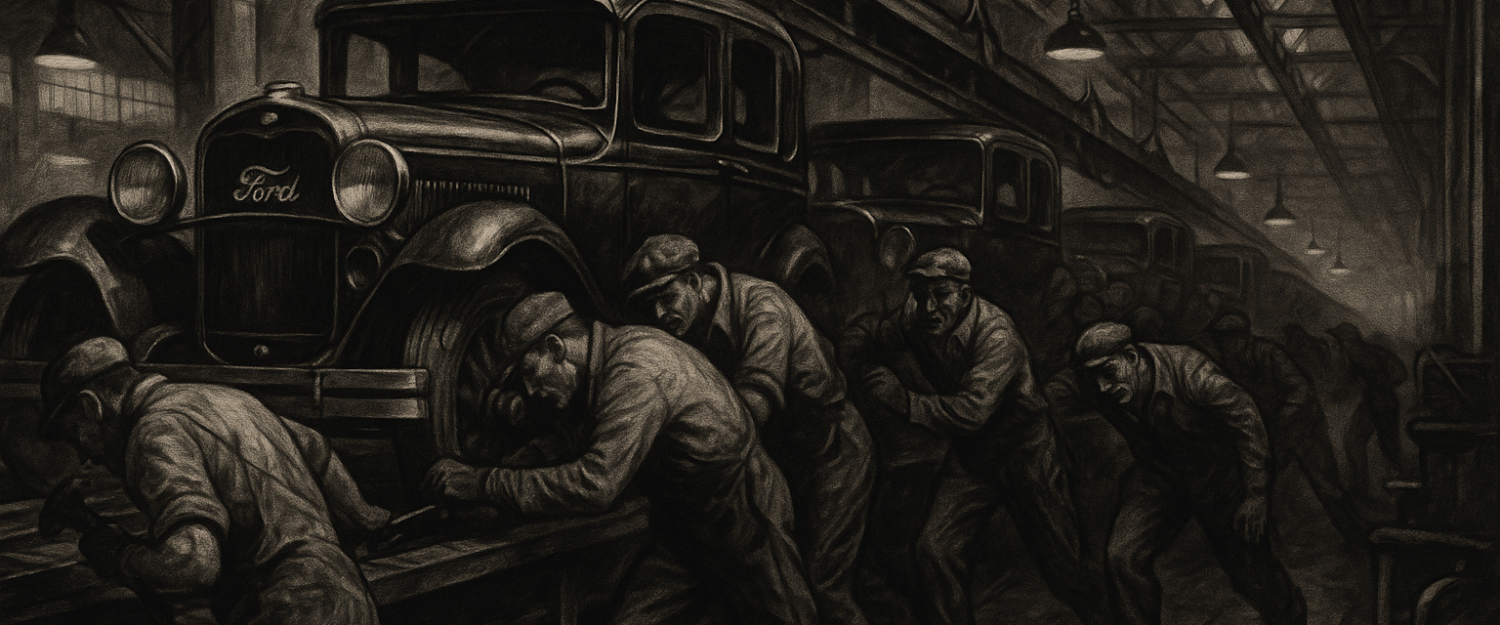

On Friday, April 2, 1937, Kansas City’s Ford Motor Company plant on Winchester Avenue became the epicenter of a labor showdown. Winter was ending, production had been high, and workers looked forward to the weekend. That day, without warning, foremen began pulling workers aside and ordering them to turn in their badges. Ford said production was being cut by 17 percent, but workers suspected something else was at play: union busting.
From his estate in Georgia, Henry Ford told the press he was slowing production to avoid taking advantage of Chrysler, then crippled by a massive sit-down strike. But inside the Kansas City plant, union members noticed that up to 90 percent of the layoffs targeted them, ignoring the usual seniority rules. Many of those laid off had decades of service, while short-term hires remained. Workers quickly saw the move as an attack on the fledgling UAW Local 249.
Local 249 had been chartered just weeks earlier on January 15, 1937, and was still meeting in secret to avoid reprisals from Ford’s notorious Service Department led by Harry Bennett. When the layoffs hit, the union’s executive committee told workers to stay put, sparking the first sit-down strike at any Ford plant in the nation. Workers called back those who had already left, posted guards at entrances, organized committees to enforce safety rules, and welded gates shut to keep out police and strikebreakers.
Henry Ford had long opposed organized labor, warning workers against joining unions. Even after the Supreme Court upheld the National Labor Relations Act in 1937, Ford and Bennett publicly vowed never to recognize the UAW. This defiance was a direct challenge to the new federal law granting workers the right to organize and bargain collectively.
The Kansas City Ford strike was part of a broader wave of unrest. That same week more than 1,300 workers in other Kansas City plants were also on strike. Nationwide, nearly 1,000 strikes erupted in the first quarter of 1937, part of a wave of worker militancy that rivaled the strike record set during World War I.
UAW spokesman Homer Kelley demanded Ford follow seniority rules by reinstating veteran workers and laying off newer hires instead. Ford refused. Despite tensions, the Kansas City sit-down remained peaceful, with only eight police officers stationed to control traffic and large crowds of supporters.
Outside Gate 6, wives and children delivered food and shouted encouragement. Supporters used twine to hoist supplies to men on the roof. Families feared the financial strain if the strike failed, but they stood with the workers.
This account of the 1937 Kansas City Ford sit-down strike is based on testimony before the National Labor Relations Board, coverage in The Kansas City Star, The Kansas City Times, The Kansas City Journal-Post, and The New York Times, and the diary of Cicero Moreland, an electrician at the Winchester plant who joined the UAW on April 6, 1937.