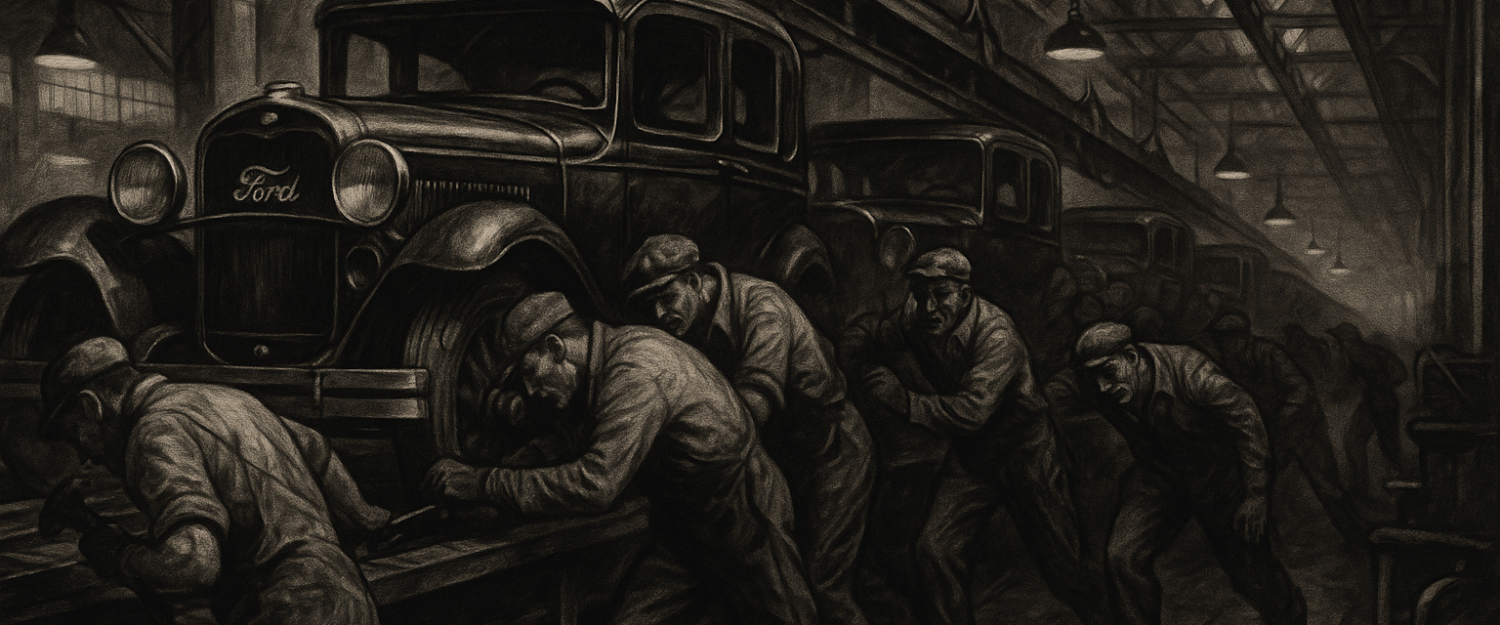

Did Henry Ford really fire an employee named John Gallo simply for smiling? Although the story circulated widely among Ford workers, there is no real proof it is true, at least not the kind that would stand up in court; it’s what we might now call an urban legend. But, true or not, the story, like all urban legends, contains a kernel of truth. Working at Ford could be hell, and Henry Ford could be the devil himself to work for.
Gene Minshall was as tough as they come. He was a former boxer and strike leader who helped lead Local 249’s effort to stop the armed scab caravans Ford brought into the Kansas City Assembly Plant to break the union in 1937. In time, the respect he earned from union members in those battles repeatedly won him the presidency of the local union.
But tough as he was, the inhuman pace of the production numbers demanded of the men remained stuck in Minshall’s brain decades after unionization finally brought them to an end.
“In 1934–35–36 … we would build 536 units in 480 minutes … that figures out 53.4 seconds per car,” he said. “Now, that is travelling! And we had no kind of power tools, just plain old tools, and elbow grease … If you didn’t do 80 motors in 8 hours, you were fired. And I couldn’t hardly make it.”
By 1937, anger at the intolerable working conditions fueled the organizing drive that gave birth to UAW Local 249 at the Ford Motor Kansas City Assembly Plant, then located at 1027 Winchester Ave. in the city’s Sheffield District.
It wasn’t about the money, Minshall later recalled in a series of articles titled “We Work at Ford” published in the Local 249 News in 1974. Even before the Depression, “workers in the auto industry enjoyed a substantially higher wage than other production workers in many other industries,” he said.
Although the pay at Ford was better than at other employers at the time, workers never knew how long it would take them to earn it. Ford bragged that he’d reduced the workday to eight hours, but the truth was that the day was never done until the plant’s production goals were met. If there was a breakdown, a whistle sounded, and the men were sent outside to wait until the equipment was repaired. When the line was running again, it sounded again to call them back to finish the day’s production quota. They never knew from one day to the next how many hours they would be at the plant to earn eight hours’ pay.
If the lines were running smoothly and there were no breakdowns, the plant might build an extra 300 jobs a week to put in storage lots to be shipped to dealers later. When that happened, workers might find themselves laid off without pay or working short days, resulting in a smaller paycheck.
Although workers could never be sure how long it might take them to earn a day’s wages, it was the unendurable working conditions at the Kansas City Ford plant that pushed them to join the UAW. The painful memories of what they endured in those days were etched so deeply in the minds of the men who worked there in the years leading up to the sit-down strike that they had no trouble recalling them decades after the organizing victory of the United Auto Workers brought them to an end.
“In January, it was twelve below zero outside, and the department where I worked at Ford Motor Company was unheated,” Dow Ellison recalled. “But I had to work so hard at such a fast pace that I was literally soaked with sweat… When I went out later in the evening to leave the plant … my socks was soakin’ wet and I caught the flu … But I dared not stay home.”
Being tired, sick, needing to use the restroom, or getting a drink of water and failing to keep pace with the jobs moving down the assembly line wasn’t an option, either. Ford worker J.D. Clark recalled that in those days, supervisors put pressure on men who were falling behind by taking them to a plant window and showing them the large crowd of desperate men waiting across the street in Ford Park, looking for a job.
Look, they said, “There’s five hundred men out there looking for your job!”
There was no relief man to do your operation if you had to go to the toilet or get a drink of water, Minshall added. “Many a worker wet his pants because he was afraid to leave his operation to get a drink of water or go to the toilet … those that did wet their pants weren’t too embarrassed because their clothing was already soaked with sweat.”
Workers at the Ford Motor Kansas City Assembly Plant first began to see a way to throw off the yoke of Fordism in 1935 when Congress passed and President Franklin D. Roosevelt signed the National Labor Relations Act (NLRA) into law. For the first time in American history, the new law gave working people like them the right to join a union, to bargain collectively over wages, hours, and working conditions, and to strike. The law also created the National Labor Relations Board (NLRB), which was tasked with enforcing the law.
That same year, the Committee for Industrial Organization (CIO) and the United Auto Workers union were formed and quickly abandoned the outmoded policies enforced on the labor movement by the American Federation of Labor (AFL), which had long blocked the organizing of workers in mass production industries, leaving them defenseless against the immense power of industrialists like Henry Ford.
The UAW and other CIO unions quickly set about bringing both skilled and unskilled workers into the new industrial unions. The new organizing strategy employed by the CIO unions had a galvanizing effect. Within months, the UAW declared victory at both General Motors and Chrysler amid a tidal wave of victories in other industrial sectors, including at Goodyear and U.S. Steel.
With the right to organize guaranteed by the government and a revitalized labor movement as their vehicle, workers at the Ford Motor Kansas City Assembly Plant – like millions of others across the country – drove forward with their own organizing drive.
Local 249’s organizing drive quickly signed up the majority of men working at the Kansas City Assembly Plant. Still, the road to union recognition and a contract agreement with Ford would prove long and arduous.
Success in those early months — it became the first Ford local to obtain a charter from the UAW and the first to challenge the dictatorial power of Henry Ford with a sit-down strike — gave way to adversity when Henry Ford ignored the law and locked them out rather than negotiate.
It took three years and nine months of hardship, but they never broke. Out of Henry’s hell, they forged something that lasted — a union built on solidarity, courage, and faith in each other.
© 2025 Pat Hayes