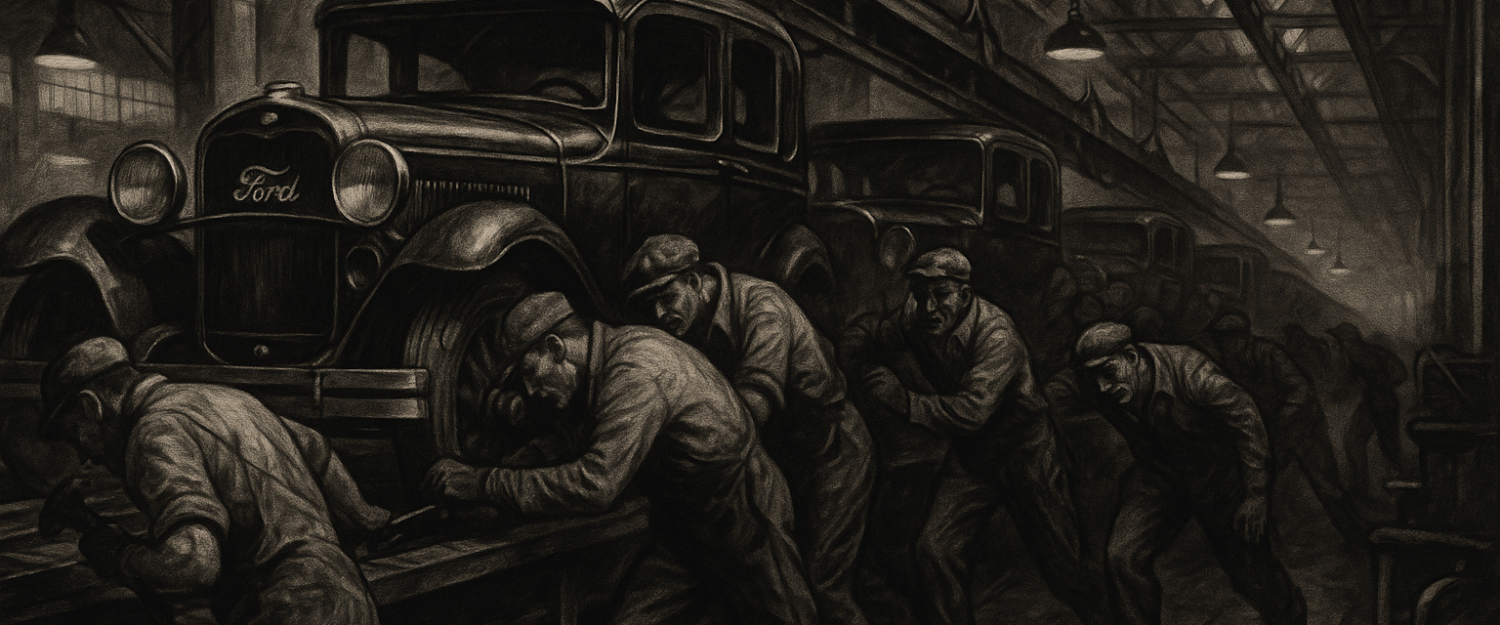

A century ago, Henry Ford built a private spy army to stop the UAW from organizing his plants. He hired bruisers, informants, and stool pigeons to follow workers, listen to their conversations, and report anyone who even whispered the word union. Today, the Trump administration is attempting the same thing, only on a bigger scale and with far more power. The old system was run by the company. The new system is operated by the government. Instead of someone lurking near the time clock, it is a federal database listening to what you say online. Instead of a foreman’s blacklist, it is an immigration file or work authorization screening. The goal has not changed. Silence workers, break solidarity, and prevent collective action before it starts.
To understand why this matters, it helps to remember how Ford’s system worked. Ford did not stop at controlling the shop floor. He wanted to control workers themselves. He built something called the Service Department under Harry Bennett, a former prizefighter who ran Ford’s labor relations like a secret police operation. The Service Department planted spies on the line, leaned on supervisors to report conversations, and sent men into neighborhood taverns to listen for union talk. A worker who stepped out of line could be fired without explanation, or followed home, or roughed up in a nearby alley. This was not paranoia. It is in the history books, the court testimony, the FBI files, and the stories workers told their children.
At the same time, Ford’s Sociological Department went into workers’ homes to inspect how they lived. They asked about savings accounts. They checked whether children went to school. They commented on household cleanliness. A worker could lose his job for having too little in a bank account or too many relatives under the same roof. Ford claimed this was uplifting. Workers understood it was surveillance.
This control lasted until workers fought back. It took sit-downs, mass picket lines, and communities linking arms across race, language, and neighborhood to break that private spy system. It also took the National Labor Relations Act, known as the Wagner Act, which made it illegal for employers to spy on or punish workers for union organizing. The law recognized a simple fact: workers cannot build power if the boss is always watching. The Wagner Act did not hand workers anything, but it created space for workers to talk, plan, and act together without living in fear.
Today we are watching that space shrink again. The UAW, together with other unions and the Electronic Frontier Foundation, has filed suit against the Trump administration over a federal program that monitors workers’ social media activities and flags so-called “disfavored viewpoints” for immigration and employment consequences. The case lays out how the government is collecting posts, likes, shares, and comments and using them to shape decisions that can determine whether a person is allowed to enter or remain in the country, whether they can get a work visa renewed, or whether they are flagged for further investigation.
This is not the boss spying on you in the break room. It is the government watching you in your home. The stakes are higher. Ford’s spies could get a worker fired. This system can separate families, block visas, trigger deportation, and spread fear throughout entire workplaces. When workers believe that speaking in support of a contract fight or posting a photo of a rally could be used against them, they hesitate. They speak less. They share less. They organize less. That is the intention. The technology is new, but the purpose is the same. Power wants silence.
This is why the UAW is taking a stand. The union defends all of its members, including immigrant members who have always been part of the backbone of this movement. Immigrants were on the line in the Flint sit-down strikes. Immigrants helped hold the picket at River Rouge. Immigrants took the risks that forced Ford to recognize the union in Kansas City. They have stood with us in every contract fight since. The UAW has always known that a workplace divided by citizenship, birthplace, or language is a workplace the boss can control. Our strength has never come from being the same. It has come from standing together.
When the government uses surveillance to frighten immigrant workers into silence, it is targeting the entire union. It is trying to weaken the power that comes from workers speaking openly to one another about their conditions, their rights, and their plans for action. The lesson from our own history is clear. The only way to defeat a system built to make us feel isolated is to insist that no one stands alone. The union was built by workers who refused to be intimidated and refused to let others be singled out. That remains the path forward now.
© 2025 Pat Hayes
