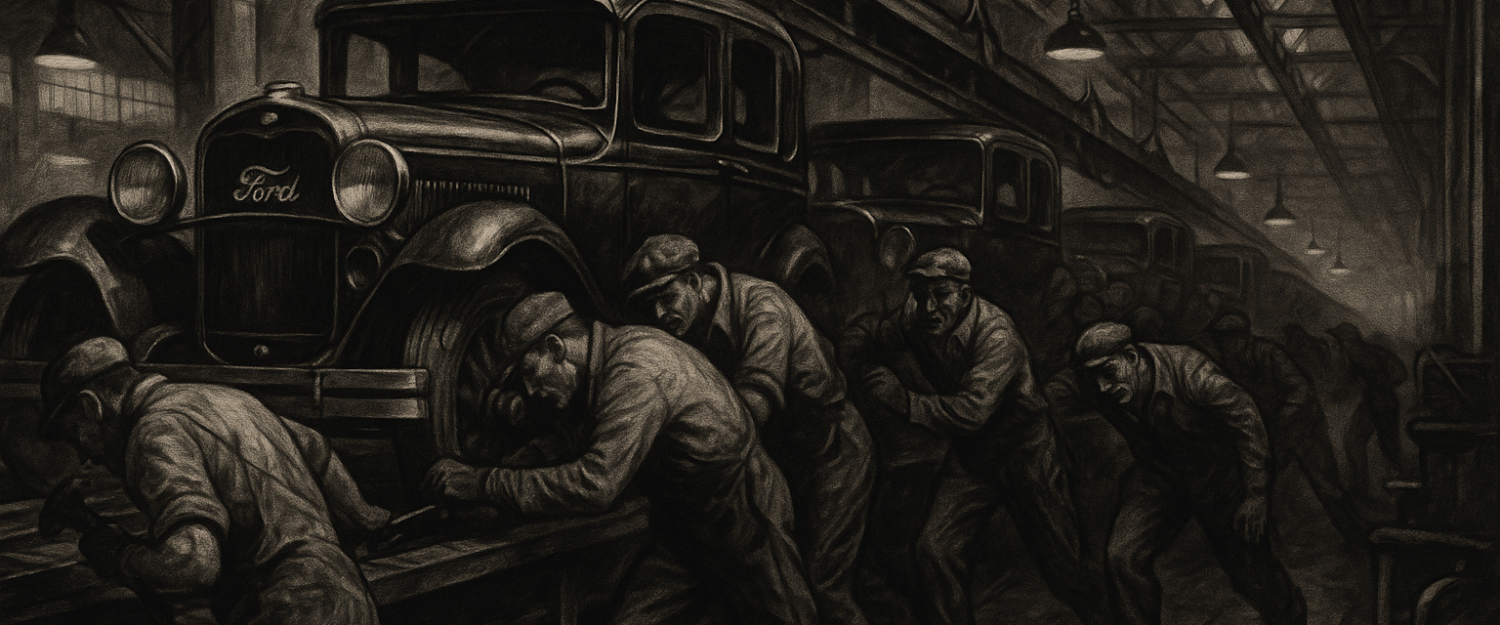

On Friday, April 2, 1937, Kansas City autoworkers at the Ford Motor Company’s Winchester Avenue plant made history. Fed up with union-busting tactics, unfair layoffs, and brutal working conditions, members of what would become UAW Local 249 launched the first-ever sit-down strike at a Ford plant — a bold act of defiance that echoed across the American labor movement.
Fast forward to 2023: United Auto Workers across the country reignited that fighting spirit with the Stand-Up Strike, a strategic new wave of walkouts aimed at winning back power from billion-dollar corporations. But long before these modern battles, Kansas City workers showed what solidarity could do—by literally sitting down.
Ford’s “Seasonal” Layoffs Were Anything But
It was a warm spring day. Workers had just finished building 538 vehicles that week and were looking forward to a weekend away from the hard, dirty work of auto assembly. But as they lined up at the time clock to punch out at 3:15 p.m., foremen began pulling men aside, telling them to hand in their company badges. Production was being cut to 450 units a day, they were told.
The excuse? A 17% cut in production, supposedly to avoid taking unfair advantage of Chrysler, which had been shut down by a sit-down strike of 6,000 workers weeks earlier.
But workers at the Winchester plant saw through the lie. Nearly 90% of those being laid off were known union supporters, despite having more seniority than those being kept on. Some had worked there over two decades, while the men replacing them had only been on the job for a few months.
Union Men Targeted in Retaliatory Firings
The layoffs weren’t seasonal—they were strategic. Ford management hoped to crush the UAW organizing drive at the plant before it could take root.
Local 249 had just been chartered on Jan. 15, 1937. Operating in secret to avoid retaliation by Harry Bennett’s Ford Service Department thugs, the union had elected an 18-man executive committee led by Baron DeLouis. Other key organizers included Walter Williams, Pat Monroe, L.L. Oliver, Ray Dunn, Frank Bell, Homer Kelley, and Henry Rees.
When the layoffs hit, the union refused to back down. They told men not to leave the plant or turn in their badges. They called back Chassis Department workers who had already punched out and placed guards at the entrances.
That was the beginning of the first sit-down strike at any Ford Motor Co. plant in the nation.
How the Sit-Down Was Organized from the Inside
Inside the plant, organizers quickly created committees to maintain order, prevent smoking and drinking, and guard against fire hazards. Others patrolled gates and entrances.
Strikers were allowed short breaks to eat or smoke off-site, but by 11 p.m., union men had welded shut the gates to prevent police or scabs from breaking the strike overnight.
Workers had every reason to expect violence. Abuse from supervisors was routine. In fact, its sudden absence was alarming. “No rough bossing going on as before,” wrote worker Cicero Moreland in his diary. “Something wrong!”
Henry Ford and Harry Bennett were clear: they opposed all unions. Just weeks earlier, Ford had warned workers to stay out of labor organizations. After the Supreme Court upheld the National Labor Relations Act (Wagner Act) on April 12, giving workers the legal right to organize, Ford flat-out refused to comply.
“We’ll never recognize the United Automobile Workers union or any other union,” he said. Bennett was even more blunt: the law “did not exist for him.”
Worker Solidarity Shuts Down the Plant
Despite the threats, union leaders asserted that more than 1,400 workers occupied the plant. They demanded layoffs be done by seniority, not union affiliation.
“Most of the men they laid off are union men, and older in point of service than the non-union men they kept on the payroll,” union spokesman Homer Kelley told reporters.
“If the company will put the old men back to work and lay the new men off, we’ll call off the strike,” Kelley added. “We don’t have any complaint about a seasonal layoff. But this isn’t that.”
Solidarity on the Shop Floor and at Home
Against all odds, the sit-down remained peaceful. The city sent only eight police officers to direct traffic. Outside the plant, a growing crowd of supporters gathered. Wives and children of the strikers came to speak with their husbands, shout encouragement, and hoist food via twine ropes up to the roof.
“Who says we can’t take Ford?” the crowd shouted across the fence, according to the Kansas City Times.
But for the families, the risk was real.
“I’ve seen this coming a long time and I just can’t be happy about it,” said one mother watching the crowd with another across the street from the plant.
Kansas City Takes the Lead in Auto Worker Resistance
The 1937 Ford sit-down strike in Kansas City wasn’t an isolated event. It was part of a massive wave of labor unrest. That same week, more than 1,300 workers across Kansas City were on strike at garment factories, dairies, and metal shops. In the first three months of 1937 alone, nearly 1,000 strikes were recorded nationwide. By year’s end, the number of strikes would likely top the previous record of 4,450 set in 1917.
But this was the first time Ford Motor Company workers had occupied one of its plants—and it wouldn’t be the last.
Legacy of the 1937 Strike: From Sit-Down to Stand-Up
Unlike the strikes at General Motors and Chrysler, the 1937 Winchester Avenue sit-down strike marked not the end, but the beginning of a long, bitter struggle to win union recognition at Ford. Even so, it proved that even in the face of corporate intimidation and government indifference, worker solidarity could bring a giant to its knees.
Eighty-six years later, in 2023, UAW members launched a new kind of strike—the Stand-Up Strike — building on the legacy of those Kansas City pioneers. Their demands may be different, but the message is the same:
This account is based on NLRB testimony, coverage in The Kansas City Star, The Kansas City Times, The Kansas City Journal-Post, The New York Times, and the diary of Cicero Moreland, an electrician at the Winchester plant who joined the UAW on April 6, 1937.
ChatGPT has been used for search engine optimization.
©Pat Hayes 2013