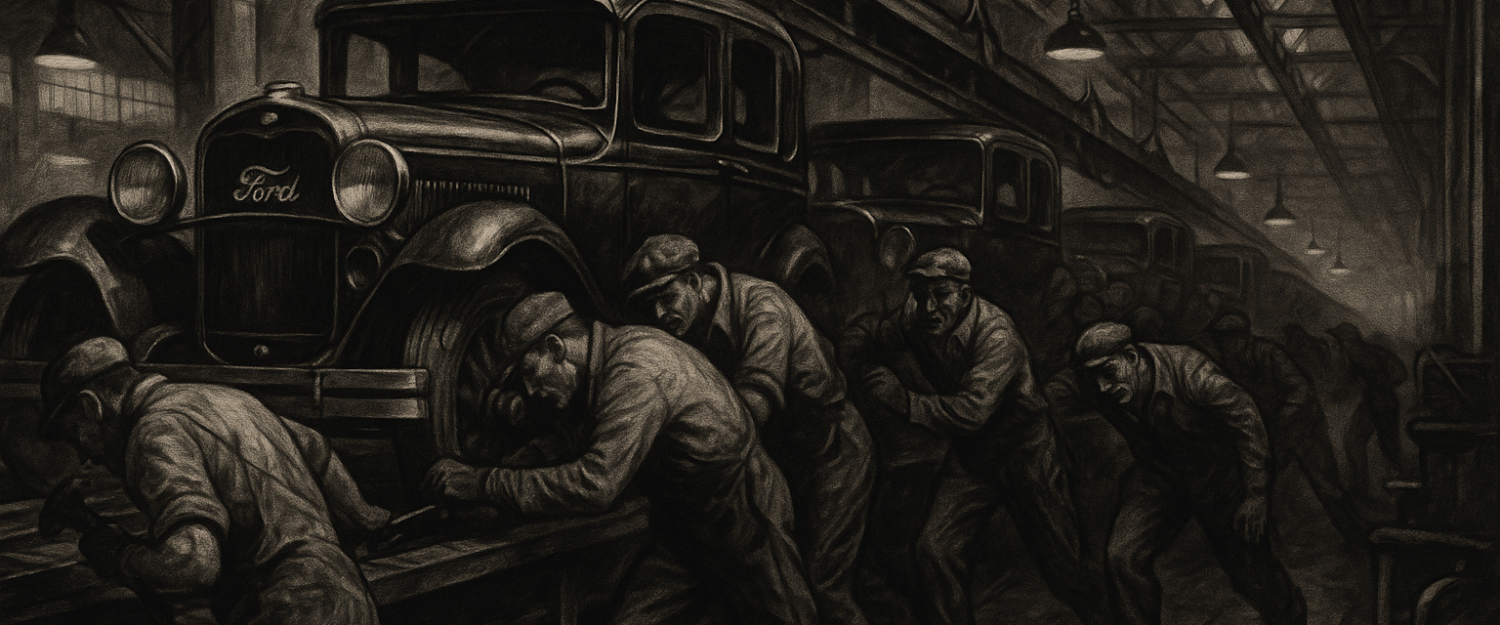

Workers at the General Motors Chevrolet—Fisher Body plant hadn’t had time to wash the dirt from their hands before climbing the steps of the Atheneum Club on Linwood Avenue in Kansas City on Saturday, April 28, 1934. Passing through four imposing Greek Revival columns at the entrance, 400 autoworkers jammed the formal auditorium. The overflow crowd buzzed with anticipation while Federated Automobile Workers Local 2 President W. G. Patterson and Vice-President Homer Martin greeted the flood of workers from the stage.
A worker in stained coveralls rose from the floor to protest the elimination of the night shift and the loss of more than 1,000 jobs. Wives nodded in agreement as their husbands denounced the discharge of as many as 60 union members on the day shift and their replacement by low-seniority nonunion men from the night shift.
The company’s claim that the workers were fired for incompetence provoked mocking laughter from the floor. Other claims that the loss of the shift was due to the restrictions imposed by the National Recovery Act or the strike at the St. Louis Fisher Body plant were greeted with murmurs of disbelief.
Find Labor Hostory Now on Facebook
Jack Swift, a paint sprayer at the plant, pointed out the suspicious nature of the terminations. He said that workers had been handed their final paychecks immediately upon being let go. This sudden payout deviated sharply from the plant’s established routine, where wages were typically distributed only on Saturdays or Mondays.
Swift argued that this irregularity was part of a broader corporate strategy. He linked the dismissals to a recent speech by General Motors President Alfred P. Sloan, Jr., which signaled a firm stance against independent labor organizations. According to Swift, these actions demonstrated that the company was systematically identifying and removing union supporters from its workforce.
Patterson read a report from an advisory committee composed of Leeds workers recommending a strike to demand union recognition, restore the jobs of the fired union members, and enforce seniority rules in future layoffs. The hall voted enthusiastically to recommend a strike at the Leeds plant starting Monday morning, when the day shift workers would return. It was also decided to hold a second meeting to allow more workers to participate in the decision-making and to plan the logistics of the strike.
The following night, more than 1,000 Leeds workers returned to the Atheneum this time to plan the strike.
“We shall remain out until our demands are met,” said Patterson. “This is not a strike in sympathy with the workers of other cities, although they have our sympathy, but for the purpose of adjusting our own grievance.”
One observer described the meeting this way:
“There was informality about the meeting. Workmen with oil-creased hands sat holding infant children on their laps, their wives beside them. Patterson spoke as though he were in conversation, and from the ranks came answers, suggestions, and always encouragement. Once, a man—scores of years older than the average workman—made a suggestion on picket duty. From the front row, a voice said, ‘He’s got more brains than teeth.’ There was no laughter at the sally. Heads nodded in agreement.”
Around the edges of the meeting hall, workers shared news about the weeklong strike by 8,400 autoworkers at the Cleveland Fisher Body plant. The plant produced components for many other General Motors plants across the country. It contained the only body stamping dies for GM’s Pontiac models. Veteran autoworkers understood that shutting down Cleveland created a chokepoint that put enormous pressure on the company to settle.
A vote was taken to begin picketing the following morning when the day shift was scheduled to report for work. A strike headquarters was opened a few blocks from the plant. Volunteers were assigned to the commissary committee to ensure pickets had food and water during the day.
Once the strike plan was adopted, Patterson warned against carrying weapons on the picket line. “There must be no violence,” he said.
Jack Swift, who served as a member of the Adjustment Committee, then took the stage.
“Any man who reports for picket duty that’s oiled will be taken for a ride,” he said, thumping the podium. “I don’t mean he’ll be hurt. He’s a brother, and he’ll be treated right. But we’re going to have disposal cars, and by that, I mean cars that can take anybody out of line for a ride over to Lees Summit. From there, the guy can walk back.”
Cheers erupted when Patterson read a telegram from striking Fisher Body workers in St. Louis pledging not to return to work until their demands were met.
As the meeting broke up, it was announced that the Kansas City local of the Brotherhood of Railroad Trainmen pledged to supply 100 experienced pickets. More significantly, the trainmen pledged not to move parts into the plant or finished cars out of the plant.
This is Part 1 of a three-part series on the 1934 Fisher Body strikes in Cleveland, Kansas City, St. Louis, and Tarrytown.
Sources:
Mass meeting of approximately 400 Chevrolet–Fisher Body workers at the Atheneum (Athenaeum Club), Linwood Boulevard and Campbell Street, Kansas City, on Saturday, April 28, 1934; attendance exceeding hall capacity; leadership by W. G. Patterson (president) and Homer Martin (vice-president) of Kansas City Local No. 2, Federated Automobile Workers of America; reported in Kansas City Star, April 28, 1934, p. 3; Kansas City Times, April 30, 1934.
Worker grievances presented at the April 28 meeting, including elimination of the night shift with the loss of approximately 1,000 jobs; discharge of forty to sixty day-shift workers alleged to be active in the union; replacement by lower-seniority night-shift men; and management claims of “incompetence” and National Recovery Act restrictions; summarized from floor statements and committee reports in Kansas City Star, April 28–29, 1934; Kansas City Times, April 30, 1934.
Statements by Jack Swift, paint sprayer and member of the adjustment/advisory committee, charging discriminatory firings of union supporters; allegation that discharged men were issued paychecks immediately rather than on customary Saturday or Monday paydays; attribution of the dismissals to policies articulated by General Motors president Alfred P. Sloan Jr. opposing independent labor unions; reported in Kansas City Star, April 28, 1934.
Recommendation by an advisory committee of Leeds workers to strike for union recognition, reinstatement of discharged workers, and enforcement of seniority rules; committee composition and officer review; vote to recommend a strike beginning Monday morning, April 30, 1934, with a second mass meeting scheduled for formal approval and logistical planning; reported in Kansas City Star, April 28–29, 1934.
Second mass meeting at the Atheneum on the evening of April 29, 1934, attended by approximately 1,000 workers; adoption of the strike plan; opening of strike headquarters near the Leeds plant; appointment of commissary and picket committees; described in Kansas City Times, April 30, 1934; Kansas City Journal-Post, April 30, 1934.
Contemporary observer’s description of the informality and atmosphere of the Leeds meetings, including workers in oil-stained clothing, the presence of wives and children, conversational speaking style from the platform, and the remark “He’s got more brains than teeth,” noted without laughter; quoted from Kansas City Times, April 30, 1934.
Context of contemporaneous Fisher Body strikes in Cleveland (approximately 8,400 workers) and St. Louis, and worker understanding of Cleveland’s strategic importance to General Motors production; discussed in local reporting and Associated Press dispatches appearing in Kansas City newspapers, April 28–30, 1934.
Warnings by union leaders against violence and the carrying of weapons on the picket line; remarks by Jack Swift regarding discipline of intoxicated pickets and the use of “disposal cars” to remove them from strike activity without harm; reported verbatim in Kansas City Times, April 30, 1934.
Expressions of inter-city labor solidarity, including telegrams from striking Fisher Body workers in St. Louis pledging to remain out until their demands were met, and pledges from the Kansas City local of the Brotherhood of Railroad Trainmen to provide experienced pickets and to refuse movement of parts or finished automobiles during the strike; reported in Kansas City Journal-Post, April 30, 1934; Kansas City Times, April 30, 1934.
